 RESEARCH PORTFOLIO
Vibration Signal-Based Bearing Anomaly Detection
Developed an anomaly detection model for bearing vibration data, improving accuracy by 29.67%p through signal analysis and autoencoder architecture modifications.
Signal Analysis · Autoencoder · Model Architecture Improvement
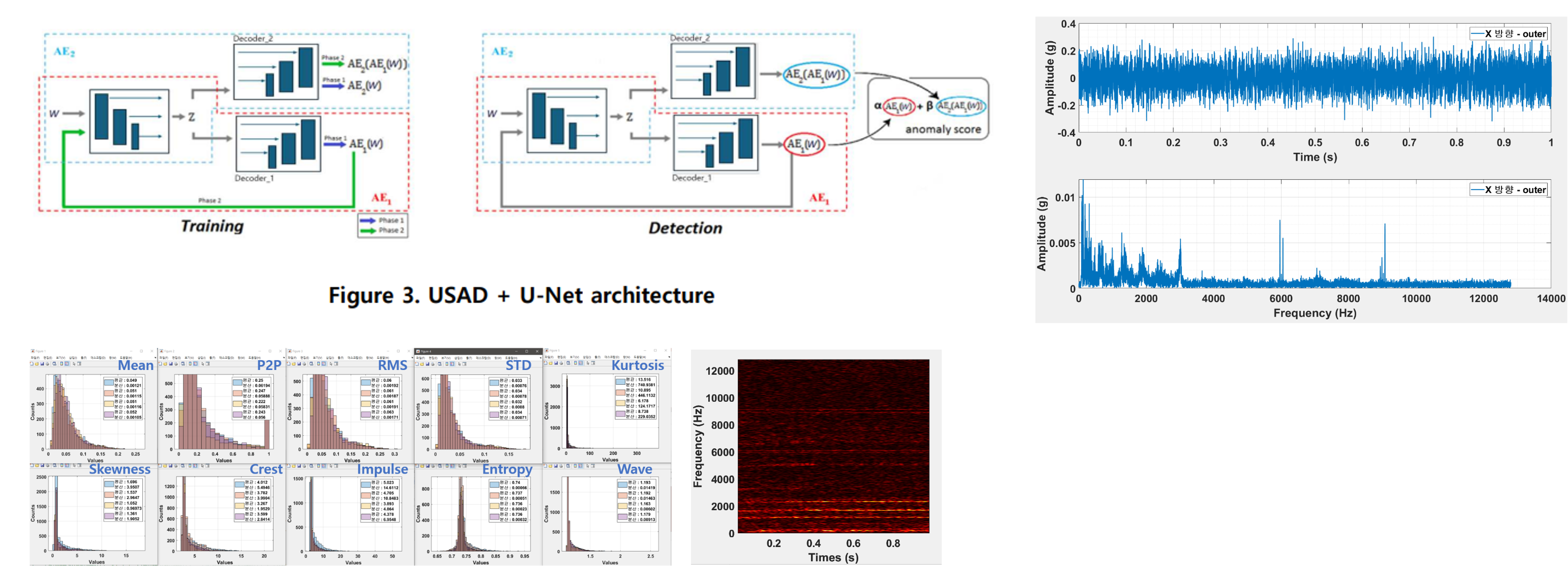
Participating in the 1st KSNVE AI Challenge in 2024, I developed a model to detect anomalies in bearing vibration data. Through experiments analyzing the characteristics of vibration signals and modifying the autoencoder architecture, I improved the accuracy from 54.83% to 84.5%, a 29.67%p increase compared to the baseline model.
Problem to Solve
I had to calculate the anomaly diagnosis score for each signal in the test data where normal and abnormal bearing data were mixed. Prior to applying the model, I aimed to understand the time and frequency characteristics of the vibration signals and find a model architecture and processing method suitable for the data.
Core Implementation
-
Vibration signal analysis
I analyzed frequency components utilizing FFT and compared signal changes and analysis results by applying various filters. I also identified the characteristics of the data by examining the distribution of statistical features such as mean, RMS, and kurtosis. -
Improvement of USAD-based anomaly detection model
I utilized the autoencoder-based approach of USAD and modified it by configuring the operations of the U-Net architecture with Linear layers instead of convolutions. I compared anomaly detection performance while changing the model architecture and training settings. -
Performance validation through iterative experiments
I experimented by changing signal processing methods and model configurations, and selected the final configuration by comparing the prediction performance of the baseline model and the improved model.