 RESEARCH PORTFOLIO
[2026 ICRA] RetoVLA: Reusing Register Tokens for Spatial Reasoning in Vision-Language-Action Models
2026 IEEE International Conference on Robotics and Automation (ICRA 2026)
- Paper Link
- Proposed experimental designs and established Sim2Real environments
Proposed Experimental Design · Built Sim-to-Real Environment · Co-author
I participated as a co-author in the research of RetoVLA (accepted to IEEE ICRA 2026), which improves the spatial reasoning capabilities of lightweight Vision-Language-Action (VLA) models. My primary contributions focused on proposing experimental design ideas and establishing the Sim-to-Real testing environment.
1. Research Background
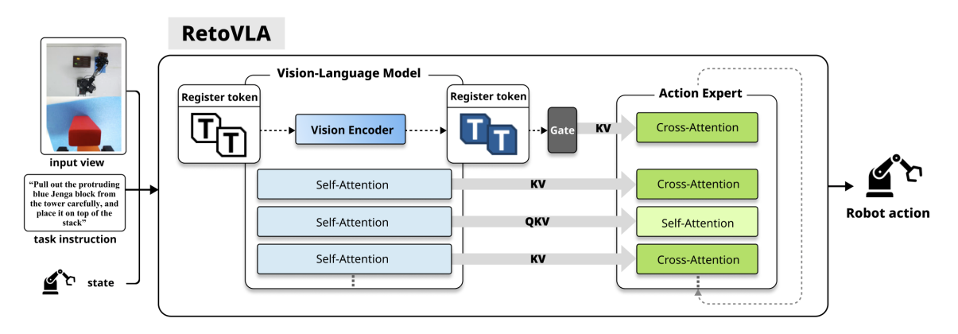
For a robot to execute natural language instructions, it must not only recognize objects but also understand the positional relationships between them and the spatial structure of the workspace. RetoVLA utilizes spatial information embedded in register tokens for action generation, thereby enhancing the spatial reasoning abilities of lightweight VLA models.
2. My Contributions
- Proposal of Experimental Design:
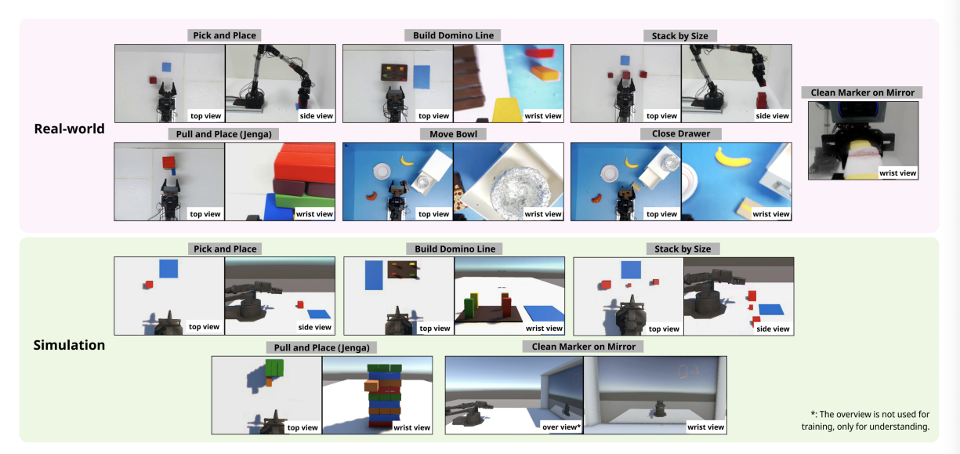
- I proposed experimental design ideas to verify the model's spatial understanding through actual robot task execution. I contributed to bridging research hypotheses with concrete tasks and evaluation scenarios.
- Construction of Sim-to-Real Environment:
- I established the experimental environment to validate the model's behavior in both simulation and physical robots. This laid the foundation for evaluating the proposed method through real-world robotic manipulation experiments.
3. Research Results
The research team evaluated the performance using the LIBERO benchmark, a simulation mirroring the physical environment, and a 7-DOF robotic arm. Across seven real-world robot tasks, the average success rate improved by 17.1%p, increasing from 50.3% (baseline SmolVLA) to 67.4%.
4. Skills & Experience Gained
Through this project, I gained experience in materializing research ideas into verifiable experiments and implementing evaluation environments utilizing both simulation and physical robots. I successfully connected experimental design with environment construction to ensure the model's performance could be validated in real-world robotic tasks.
5. Sim2real
Open original video ↗
Open original video ↗
Why Integrate MuJoCo with Unity?
Technical Requirements: Robotic manipulation experiments require visual workspace reconstruction alongside a robust physics model for joint kinematics and contact/friction handling.
Solution Architecture: Combined Unity's rendering capabilities with MuJoCo's convex optimization-based dynamics calculations via the MuJoCo Unity Plugin.
My Contributions: Bridged experimental design proposals with environment implementation, laying the foundation to validate the model's task execution in simulations corresponding to real-world experiments.